Belt-drive vs direct-drive turntables is really a choice between isolation and control. For most UK living rooms, a good belt-drive deck is the calmer, better-value buy; for DJ use, pitch control, 78rpm records, or anyone who hates belt changes, direct drive makes more sense.
In This Article
- Belt-Drive vs Direct-Drive Turntables: The Short Answer
- How a Belt-Drive Turntable Works
- How a Direct-Drive Turntable Works
- Sound Quality: What You Can Actually Hear
- Speed Stability, Pitch Control and Everyday Use
- Maintenance, Belts and Long-Term Costs
- Which Type Should You Buy?
- Frequently Asked Questions
Belt-Drive vs Direct-Drive Turntables: The Short Answer
If you are buying a turntable for relaxed home listening, start with belt drive. A Rega Planar 1 at about £299 or a Pro-Ject Debut Carbon EVO at about £449 from UK hi-fi retailers such as Richer Sounds, Sevenoaks or Audio T will usually give you more of the money where it matters: a rigid plinth, decent tonearm, sensible cartridge and low motor noise.
Direct drive is the better choice when you need fast start-up, pitch adjustment, 78rpm support, USB output, DJ-style cueing or a deck that can take rougher daily use. The Audio-Technica AT-LP120XUSB, usually around £279 to £299 in the UK, is the obvious affordable example. The Technics SL-1500C, often around £899, is the cleaner home hi-fi version of the direct-drive idea, especially if you have already read our record player vs turntable guide and know you want a separate hi-fi deck rather than an all-in-one player.
The drive system is not a magic sound-quality switch. A well-made direct-drive turntable can beat a cheap belt-drive one, and a well-made belt-drive deck can sound more settled than a noisy direct-drive model. The motor type matters, but so do the cartridge, tonearm bearings, platter, phono stage, isolation and how carefully you set everything up.
My practical rule is simple: buy belt drive if you want to sit down and listen to albums; buy direct drive if you want control over the record while it is spinning. That sounds blunt, but it saves a lot of forum wandering.
How a Belt-Drive Turntable Works
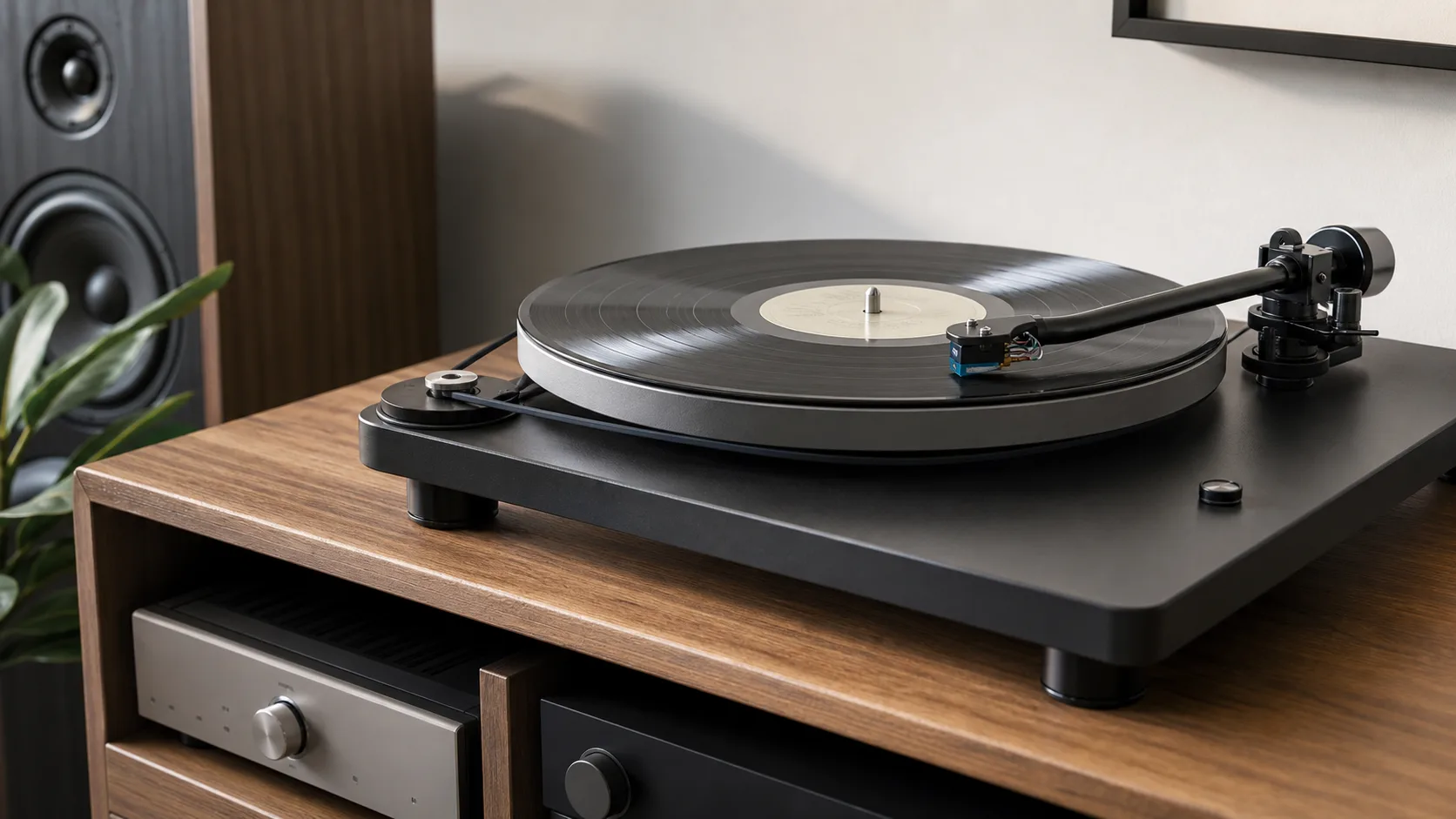
A belt-drive turntable uses a small motor to turn an elastic belt, which then rotates the platter. The belt usually sits around the outside of the platter or around a smaller sub-platter hidden underneath. The record does not sit directly on the motor shaft.
That separation is the point. The belt acts as a soft link between the motor and the platter, so less motor vibration reaches the stylus. On a decent hi-fi system, that can make quiet passages feel cleaner and less mechanically busy. You are not hearing the belt; you are hearing the lack of motor chatter getting into the cartridge.
Why belt drive suits home listening
Belt-drive decks tend to be simple in the best way. The Rega Planar 1 is a good example: manual operation, light rigid plinth, fixed cartridge alignment from the factory and no DJ features to distract from playing records. Rega describes the Planar 1 as a plug-and-play deck with a factory-fitted Carbon cartridge and RB110 tonearm, which is why it suits first proper vinyl systems rather than fiddly hobby setups. See Rega’s product information for the Planar 1 turntable if you want the manufacturer spec, then use our beginner turntable setup guide when it arrives.
The Pro-Ject Debut Carbon EVO is the step-up version I would look at if the budget allows. At about £449, it gets you a carbon tonearm, heavier feel and cleaner upgrade path than most sub-£300 decks. It is still a belt-drive turntable, but it feels less like an entry-level compromise.
The belt-drive trade-offs
The downside is that the belt is a wearing part. It can stretch, slip, dry out or pick up dust and finger grease. Most users will not notice for years, but if the piano on a record starts sounding slightly seasick, the belt is one of the first things to check.
You also get less instant control. Some belt-drive decks need you to move the belt manually between pulleys for 33 and 45rpm. Others have electronic speed switching, but start-up is still slower than a direct-drive deck. That does not matter for playing a Nick Drake album on a Sunday morning. It matters if you want to cue records quickly or change speed often.
How a Direct-Drive Turntable Works
A direct-drive turntable puts the motor directly under the platter. There is no rubber belt between the motor and the rotating surface. The platter is driven by the motor itself, often with electronic speed control to hold it at 33, 45 or sometimes 78rpm.
That gives direct drive its main advantages: strong torque, quick start-up, fast braking and stable speed control. It is why club decks use direct drive. When a DJ touches the record, cues a track or adjusts pitch, the platter needs to recover quickly and predictably.
Why direct drive is not just for DJs
The old lazy take is that direct drive means DJ gear and belt drive means hi-fi. That is too neat. The Technics SL-1500C is a home listening deck, not a club tool, and it uses direct drive because Technics has spent decades refining that motor system. Richer Sounds lists the Technics SL-1500C as a direct-drive turntable with built-in phono stage and detachable RCA output, which is exactly the sort of clean, living-room-friendly direct drive that makes sense outside DJ use.
The Audio-Technica AT-LP120XUSB sits at the more affordable end. It has pitch control, USB output, a built-in phono preamp and 78rpm playback, usually for under £300. If you want to digitise old records or play shellac 78s with the right stylus, that feature set is hard to ignore.
The direct-drive trade-offs
Cheap direct-drive decks can feel busy. More controls, more electronics, strobe dots, pitch sliders and USB features can make the deck look clever while the arm and cartridge are only average. That is where buyers get caught.
There is also a noise question. A poor direct-drive motor can pass tiny mechanical vibration into the platter. Modern good ones are much better than old stereotypes suggest, but at the budget end I would still take a stripped-back belt-drive hi-fi deck over a flashy direct-drive model if the goal is pure album listening.
Sound Quality: What You Can Actually Hear
The biggest audible difference is not “belt drive sounds warm” and “direct drive sounds clinical”. That is hi-fi pub talk. What you may hear is a difference in noise, timing and confidence, and even then only if the rest of the system is revealing enough.
On a modest setup with powered speakers under £200, the cartridge and speaker placement will usually matter more than the drive system. On a better system with a decent phono stage and speakers set up properly, the quietness of the deck becomes more obvious.
Where belt drive can sound better
Belt-drive turntables can sound nicely unforced because the motor is isolated from the platter. On records with sparse arrangements, you may hear a blacker background and a calmer sense of flow. A belt-drive Rega or Pro-Ject also avoids unnecessary features, which means the money goes into mechanical basics.
The Rega Planar 1 at about £299 is a better listening-first buy than many feature-heavy decks at the same price. It does not have USB. It does not have Bluetooth. It does not have pitch control. Good. Those things are not free, and on a budget deck they often come at the expense of the parts that touch the record.
Where direct drive can sound better
Direct drive can sound firmer and more rhythmically locked, especially on well-engineered models. The Technics SL-1500C is not cheap at about £899, but it gives you stable speed, low-maintenance ownership and a built-in phono stage that keeps setup tidy. If you have a large record collection and play vinyl most evenings, that robustness starts to feel like value rather than luxury.
The Audio-Technica AT-LP120XUSB is not as refined, but it is useful. Owners often like that it gives them USB recording, pitch adjustment and a removable headshell without needing a pile of accessories on day one. I would not buy it over a Pro-Ject Debut Carbon EVO for quiet jazz and acoustic records, but for mixed use it earns its place.

Speed Stability, Pitch Control and Everyday Use
Speed stability is where direct drive has a natural advantage. Because the motor controls the platter directly, the deck can correct speed quickly. That helps with pitch-sensitive music, long piano notes and anyone who notices when a record sounds a shade slow.
Belt-drive speed stability depends on the motor, belt, pulley and platter working together. Good belt-drive decks are stable enough for normal listening, but a stretched belt or dirty pulley can cause small pitch errors. If you buy second-hand, that is one reason a £20 belt replacement is often the first sensible job.
Speed switching
Some belt-drive decks make you lift the platter and move the belt to switch between 33 and 45rpm. It is not difficult, but it is a faff if you play a lot of singles. Pro-Ject’s Debut Carbon EVO is better here because it has electronic speed control for 33 and 45, which makes day-to-day use easier. If your records are already living near a radiator or stacked flat under the deck, fix that first with our vinyl record storage guide.
Direct-drive decks usually have buttons for speed changes. Many also include 78rpm, though you still need a proper 78rpm stylus before playing shellac records. Do not run old 78s with the normal elliptical stylus supplied for LPs unless you enjoy ruining both record and stylus.
Pitch control
Pitch control is useful for DJs, musicians practising along with records, and people transferring old vinyl to digital where the original pressing runs slightly off. It is less useful for normal listening. In fact, I prefer not having it on a living-room deck because it removes one more thing to knock by accident.
This is where the belt-drive vs direct-drive turntables decision becomes less about sound and more about behaviour. If you want to press play and leave the deck alone, belt drive is elegant. If you want to interact with the platter, direct drive is the correct tool.
Maintenance, Belts and Long-Term Costs
Belt-drive maintenance is cheap but real. A replacement belt usually costs about £15 to £30 from UK hi-fi shops, depending on the brand. Rega and Pro-Ject belts are easy to find, and changing one takes a minute once you know where it sits.
You should also keep the belt and pulley clean. Wash your hands before handling the belt, avoid stretching it, and do not leave the deck near a radiator. UK houses can be rough on hi-fi: warm bay window in the afternoon, cold wall at night, then central heating blasting in winter. Rubber parts do not love that.
Direct-drive maintenance
Direct-drive decks do not need belt changes, which is their quiet ownership win. There are still parts to maintain: stylus, cartridge, cueing mechanism, hinges, dust cover and occasionally pitch controls. But the drive system itself is less of a consumable.
Stylus cost applies to both types. An Audio-Technica VM95E replacement stylus is usually about £25 to £35 in the UK. An Ortofon 2M Red stylus is more like £65 to £85. If you play records daily, budget for stylus replacement before you budget for fancy mats or record weights.
Running costs that matter more than drive type
The most common hidden cost is not the belt. It is buying the wrong deck for your amplifier. If your amp or powered speakers do not have a phono input, you need a phono stage. Budget around £49 to £79 for something basic such as a Pro-Ject Phono Box E or Rega Fono Mini A2D when discounted, unless your turntable has a built-in preamp.
That is where direct-drive models such as the AT-LP120XUSB and Technics SL-1500C can look better value: both include a phono stage. Some belt-drive models include one too, but many purist hi-fi decks do not. If your amp has no phono input, read our phono preamp explainer before deciding the deck itself is too expensive.
Which Type Should You Buy?
Buy the deck that fits the way you actually use records, not the way hi-fi forums tell you serious people should use records.
Buy belt drive if you want a simple hi-fi deck
Belt drive is the right call for most first proper turntables. You get fewer features, less clutter and better value in the core listening parts.
Good UK picks:
- Budget hi-fi: Rega Planar 1, about £299. Best for simple album listening through a proper amp or phono stage.
- Mid-range sweet spot: Pro-Ject Debut Carbon EVO, about £449. Better if you want electronic speed change and a stronger upgrade path.
- Automatic convenience: Audio-Technica AT-LP3XBT, often about £249. Not as purist, but useful if Bluetooth and automatic operation matter.
I would buy the Rega if the system is simple and I know the owner will not fiddle. I would buy the Pro-Ject if the budget stretches and 45rpm singles are part of the plan. The same logic sits behind our beginner turntables guide: simple mechanical quality first, clever extras second.
Buy direct drive if you want control or heavy use
Direct drive suits people who play records often, need speed control or want a deck that feels less delicate.
Good UK picks:
- Budget direct drive: Audio-Technica AT-LP120XUSB, about £279 to £299. Best for USB recording, pitch control and 78rpm support.
- Premium home direct drive: Technics SL-1500C, about £899. Best for a long-term, low-fuss home system with built-in phono stage.
- DJ route: Pioneer DJ PLX-500, often about £319. Better for mixing practice than quiet hi-fi listening.
If I were buying for a living room under £500, I would still choose belt drive. If I were buying one deck to survive years of daily use, parties, digitising records and occasional pitch adjustment, I would choose direct drive.
Common Mistakes When Choosing Between Them
The first mistake is treating direct drive as automatically worse for hi-fi. It is not. Cheap direct drive can be noisy and over-featured, but good direct drive is superb. Technics built a whole reputation on getting this right.
The second mistake is assuming belt drive is always more “audiophile”. A flimsy belt-drive suitcase player is still a poor record player. If the tonearm is crude, the cartridge is poor and the tracking force is not adjustable, the belt will not save it.
Do not buy features you will not use
Bluetooth, USB, pitch control and auto-stop can be useful. They can also be distractions. If your records will be played through a Cambridge Audio or Denon amp into passive speakers, Bluetooth output is pointless. If you never digitise vinyl, USB is dead money.
Spend that money on the parts that affect every record, especially if you are comparing used decks against our best turntables under £300 picks:
- Cartridge and stylus: This reads the groove, so it matters every second.
- Tonearm quality: Bad bearings and poor tracking make records sound rough.
- Isolation: A wobbly IKEA unit beside a speaker will hurt any deck.
- Phono stage: A weak built-in preamp can flatten an otherwise decent turntable.
Do not ignore setup
A badly placed £899 direct-drive deck can sound worse than a carefully set up £299 belt-drive one. Level the shelf, keep speakers away from the turntable if possible, set tracking force correctly and replace the stylus before it is worn flat. Basic setup beats expensive arguments.
For most UK buyers, the clean answer is this: belt drive for the best value home listening deck, direct drive for control, durability and features. Neither is automatically superior. The better turntable is the one whose compromises match your room, records and patience.
Frequently Asked Questions
Is belt drive better than direct drive for sound quality? Not automatically. Belt drive often gives better value for calm home listening because the motor is isolated from the platter, but a high-quality direct-drive deck can sound cleaner than a cheap belt-drive one.
Do DJs use belt-drive or direct-drive turntables? DJs normally use direct-drive turntables because they start quickly, recover speed fast and support pitch control. Belt-drive decks feel too slow and soft for cueing, scratching or beatmatching.
How often should I replace a turntable belt? Many belts last several years, but replace yours if speed becomes unstable, the belt slips, or the rubber feels loose or shiny. In the UK, most replacement belts cost about £15 to £30.
Is the Audio-Technica AT-LP120XUSB good for home listening? Yes, if you want direct drive, USB recording, pitch control and a built-in phono stage for about £279 to £299. For pure hi-fi listening at similar money, I would still compare it with a Rega Planar 1.
Can a belt-drive turntable play 45rpm singles? Yes. Some switch speed electronically, while others need you to move the belt by hand. If you play lots of 7-inch singles, check the speed-change method before buying.
Which turntable type should a beginner buy? Most beginners should buy a simple belt-drive deck such as the Rega Planar 1 or Pro-Ject Debut Carbon EVO. Choose direct drive if you specifically need USB, pitch control, 78rpm playback or DJ-style handling.