Quick answer
The Creative Pebble V3 is the best computer speaker set for most UK desks. It is compact, supports USB-C audio and Bluetooth, and avoids the floor-space demands of a separate subwoofer. Choose the Pebble Plus for stronger bass on a tighter budget, the Edifier R1280T for fuller stereo sound, the Creative T60 for calls and headset switching, or the Pebble Pro for a more capable compact setup.
In this guide
- How we chose
- Comparison at a glance
- The five best computer speakers
- 2.0 or 2.1 speakers?
- Head-to-head buying advice
- Desk space and positioning
- Connections and power
- Frequently asked questions
How we chose
We prioritised five distinct desktop setups rather than small variations of the same product. The shortlist covers compact USB speakers, an affordable 2.1 system, larger powered bookshelf speakers, a communications-focused pair and a premium compact option.
We compared connection types, power arrangements, controls, driver layout and the amount of desk or floor space each system needs. We also checked the less obvious requirements: whether an audio cable or power adapter is included, where the volume controls sit and whether a subwoofer or larger cabinet will obstruct a small workspace. No hands-on testing is implied; recommendations are based on documented specifications and practical suitability.
Comparison at a glance
| Speaker | Best for | System | Main check |
|---|---|---|---|
| Creative Pebble V3 | Best overall | 2.0 compact | USB-C or Bluetooth source |
| Creative Pebble Plus | Best 2.1 value | 2.1 with subwoofer | Space below the desk |
| Edifier R1280T | Best for fuller stereo sound | 2.0 bookshelf | Two RCA/3.5mm sources |
| Creative T60 | Best for calls and headphones | 2.0 desktop | USB-C and call features |
| Creative Pebble Pro | Best compact premium pick | 2.0 compact | Power source for higher output |
The Pebble V3 is the safest starting point because it covers a modern laptop, Bluetooth phone and small desk without extra boxes. The other choices become better only when a particular need matters more: deeper bass, larger stereo cabinets, easier calling controls or greater compact-speaker output.
The five best computer speakers
1. Creative Pebble V3: best overall
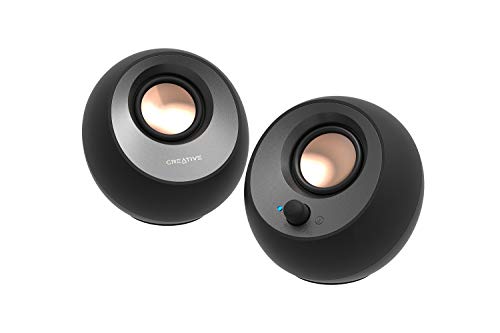
The Pebble V3 balances size, simplicity and connection flexibility. Its angled drivers direct sound towards a seated listener, while USB-C carries digital audio and power from a compatible computer. A USB-A converter is included for older machines, and Bluetooth 5.0 covers phones and tablets. There is also a 3.5mm auxiliary input, although the required cable is not included.
Creative rates the pair at 8W RMS and 16W peak, but the higher-gain mode depends on a suitable 10W USB power source. A low-output laptop port may not deliver the same headroom. The compact cabinets are ideal near a monitor, though they cannot provide the weight or separation of larger speakers.
- Buy it if: you want tidy everyday speakers for a laptop or compact desktop.
- Skip it if: you want room-filling bass or dedicated headphone controls.
- Main compromise: broad connectivity and small dimensions take priority over low-frequency extension.
2. Creative Pebble Plus: best 2.1 value

The Pebble Plus adds a separate down-firing 4-inch subwoofer to two angled satellites. That makes films and games feel fuller than a compact 2.0 pair, while the satellites still occupy little space beside a monitor. Audio enters through 3.5mm and USB supplies power, so it suits desktops with a conventional headphone or line output.
Creative quotes 8W RMS when the system uses a 5V/2A USB adapter, but that adapter is not included. The subwoofer also needs a clear position under or beside the desk, and its cable limits placement. Bass quantity improves, yet this remains an affordable multimedia system rather than a high-powered hi-fi setup.
- Buy it if: you want inexpensive extra bass for games, films and casual music.
- Skip it if: floor space is tight or your computer lacks a 3.5mm output.
- Main compromise: better bass requires an extra box, more cable management and the right power adapter.
3. Edifier R1280T: best for fuller stereo sound
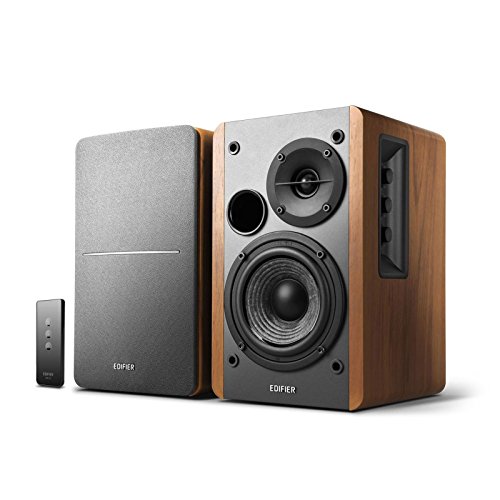
The R1280T uses larger MDF cabinets, a 4-inch full-range driver and a 13mm silk-dome tweeter in each speaker. Two RCA inputs let a computer and another line-level source remain connected, while side-mounted bass, treble and volume controls are easy to reach. A small remote controls volume from the desk or sofa.
These are considerably larger than the Creative pairs and need room to breathe on either side of the monitor. They do not include Bluetooth or USB audio, so a computer needs a suitable analogue output or DAC. A turntable also needs its own phono preamp unless it provides a line-level output.
- Buy it if: sound quality and stereo scale matter more than saving desk space.
- Skip it if: you need Bluetooth, USB audio or very small cabinets.
- Main compromise: fuller sound comes with larger speakers and analogue-only connectivity.
4. Creative T60: best for calls and headphones

The T60 is built for a desk that handles both entertainment and work calls. USB-C audio runs through a built-in DAC, Bluetooth 5.0 covers wireless sources, and the front panel provides headset, microphone and auxiliary connections. Creative also includes Clear Dialog, Surround processing and SmartComms features for supported computer setups.
The 2.75-inch full-range drivers keep the cabinets manageable but do not replace a subwoofer. Software-dependent features may require a compatible Windows or macOS setup, so they are less useful with a games console or simple analogue source. Check that the recipient actually wants call controls rather than paying for functions they will never use.
- Buy it if: one desk handles meetings, headphones, music and games.
- Skip it if: you only need a simple analogue speaker pair.
- Main compromise: extra communications features add value mainly on a compatible computer.
5. Creative Pebble Pro: best compact premium pick

The Pebble Pro keeps the familiar angled desktop shape but adds Bluetooth 5.3, USB audio, auxiliary input, a headset port and adjustable RGB lighting. Creative specifies 10W RMS and 20W peak from ordinary USB-C power, with more headroom available from an appropriate external power source. BassFlex is designed to strengthen low frequencies without a separate subwoofer.
It costs more than the Pebble V3 while remaining a compact two-speaker system. The lighting can be switched off, but buyers seeking understated bookshelf speakers may still prefer the Edifier design. As with any USB-powered speaker, confirm the computer or adapter can supply the intended power mode.
- Buy it if: you want the most capable compact Creative pair without adding a subwoofer.
- Skip it if: RGB lighting and extra output do not justify the price premium.
- Main compromise: stronger compact performance still cannot match the scale of larger cabinets.
2.0 or 2.1 speakers?
A 2.0 system has two speakers and is usually the better answer for a small desk. It keeps wiring simple, preserves legroom and can create clear left-to-right positioning when the speakers sit at roughly ear level. The Pebble V3, Edifier R1280T, T60 and Pebble Pro all follow this layout.
A 2.1 system adds a subwoofer for lower bass. The Pebble Plus is more convincing for game effects and films, but the subwoofer needs space and should not be buried in a closed cupboard. Our 2.1 desktop speaker setup guide explains placement in more detail.
Head-to-head: which speakers should you buy?
Pebble V3 vs Pebble Plus
Choose the Pebble V3 for USB-C audio, Bluetooth and a cleaner desktop. Choose the Pebble Plus when 3.5mm audio is available and deeper bass matters more than wireless convenience. The V3 is the broader laptop recommendation; the Plus is the more cinematic budget option.
Edifier R1280T vs Creative T60
Choose the Edifier pair for larger cabinets, physical tone controls and a fixed music-focused setup. Choose the T60 when USB-C, Bluetooth, headset connections and meeting features matter. Neither is universally better: one favours traditional stereo hardware, the other a multifunction computer desk.
Pebble V3 vs Pebble Pro
The V3 gives most buyers the important basics for less. The Pro earns its premium through a newer Bluetooth version, headset connectivity, lighting and greater output potential. If the desk is small and the listener plays at moderate volume, the V3 remains the sensible value choice.
Desk space and positioning
Place the left and right speakers symmetrically where possible, with the tweeters or full-range drivers aimed towards the seated listening position. Avoid hiding one cabinet behind a monitor or placing both speakers on the same side. Small stands or isolation pads can reduce reflections from the desktop.
Larger speakers need more clearance than their cabinet dimensions suggest. Leave access to side controls and rear ports, and keep cables away from monitor arms and adjustable desks. The guidance in how to position speakers applies to near-field desks as well as rooms; our small-room speaker guide covers larger alternatives.
Connections and power that matter
USB audio can bypass a noisy computer headphone socket, but USB-C does not guarantee every port supplies the same power. Bluetooth is convenient for a phone, although wired USB or analogue audio avoids wireless latency for gaming and video editing. A separate DAC can help when a desktop has no clean analogue output; see our DAC buying guide.
Do not confuse powered speakers with passive speakers. Every model here contains its own amplification and must receive power; passive hi-fi speakers need a separate amplifier. Exact watt figures are not directly comparable between brands, so use them alongside driver size, cabinet design and intended listening distance. Our guide to speaker specifications explains why.
Frequently asked questions
What are the best computer speakers for most people?
The Creative Pebble V3 is the best all-round choice here because it combines compact dimensions, USB-C audio, a USB-A adapter and Bluetooth without requiring a separate subwoofer.
Are USB speakers better than 3.5mm speakers?
USB speakers can avoid noise from a poor computer headphone output and simplify cabling. A good 3.5mm output remains perfectly suitable, and it works with more analogue sources.
Do computer speakers need a subwoofer?
No. A subwoofer adds bass impact but also takes floor space and adds cables. A well-positioned 2.0 pair is usually easier for work, speech and moderate-volume music.
Can I use Bluetooth speakers for gaming?
You can, but Bluetooth introduces latency that may make sound lag behind fast action. Use USB or a wired analogue connection when timing matters.
Can powered computer speakers connect to a turntable?
Only if the turntable has a built-in phono preamp or a separate preamp supplies a line-level signal. A raw phono output is not suitable for these line inputs.
How should computer speakers be positioned?
Put the speakers to the left and right of the monitor, aim them towards your ears and keep the layout as symmetrical as the desk allows. Avoid blocking the drivers or rear ports.
The bottom line
Buy the Creative Pebble V3 if you want the best computer speakers for a typical UK desk. The Pebble Plus is the affordable bass-first alternative, the Edifier R1280T suits a larger music-focused setup, the T60 is strongest for mixed work and calls, and the Pebble Pro is the premium compact choice.