You have finally sat down on a Friday evening, takeaway on the coffee table, curtains pulled across the bay window, and the opening scene of a new film is playing through the thin speakers in your 55-inch TV. The picture looks good, but the dialogue is small, the bass is polite, and the big action scene sounds as if it is trapped inside the screen. That is usually the moment the soundbar vs AV receiver question becomes real: do you add one neat bar under the telly, or build a proper speaker-based home cinema system?
In This Article
- Quick Answer: Soundbar vs AV Receiver
- What You Are Really Comparing
- Room Size, Seating and Neighbours
- Sound Quality and Surround Effects
- Cost, Upgrades and Long-Term Value
- Ease of Setup and Daily Use
- Which Should You Choose for Common UK Rooms?
- Buying Checklist Before You Decide
- Final Verdict: Soundbar vs AV Receiver
- Frequently Asked Questions
Quick Answer: Soundbar vs AV Receiver
For most UK living rooms, a good soundbar is the easier and tidier choice. It improves dialogue, adds scale, keeps the room uncluttered, and usually takes less than an hour to install. If you want better sound than the TV without speaker cables around skirting boards, a soundbar with a wireless subwoofer is often the sensible answer.
An AV receiver is the better choice if sound quality, real surround sound, upgrade options and long-term flexibility matter more than simplicity. It lets you connect separate speakers around the room, add a subwoofer, support multiple HDMI sources, and create a system that can grow from 3.1 to 5.1, 7.1 or Dolby Atmos.
My usual advice is this: choose a soundbar if the room is shared, neatness matters, or you mainly watch streaming TV, sport and occasional films. Choose an AV receiver if you sit down specifically to watch films, own a projector, collect Blu-rays, game on a console, or care about hearing effects move around the room rather than just appear wider at the front.
The short version:
- Pick a soundbar for convenience, clean looks, rental flats, smaller lounges and fewer cables.
- Pick an AV receiver for real surround, stronger dynamics, better stereo separation and future upgrades.
- Pick neither blindly; your room, seating position and tolerance for equipment matter as much as the specification sheet.
What You Are Really Comparing
A soundbar and an AV receiver are not two versions of the same thing. They solve the same problem in very different ways.
A soundbar is an all-in-one speaker system. It usually contains left, centre and right channels in one slim enclosure, often with side-firing or upward-firing drivers to create a wider soundstage. Many models include a wireless subwoofer, and some add wireless rear speakers.
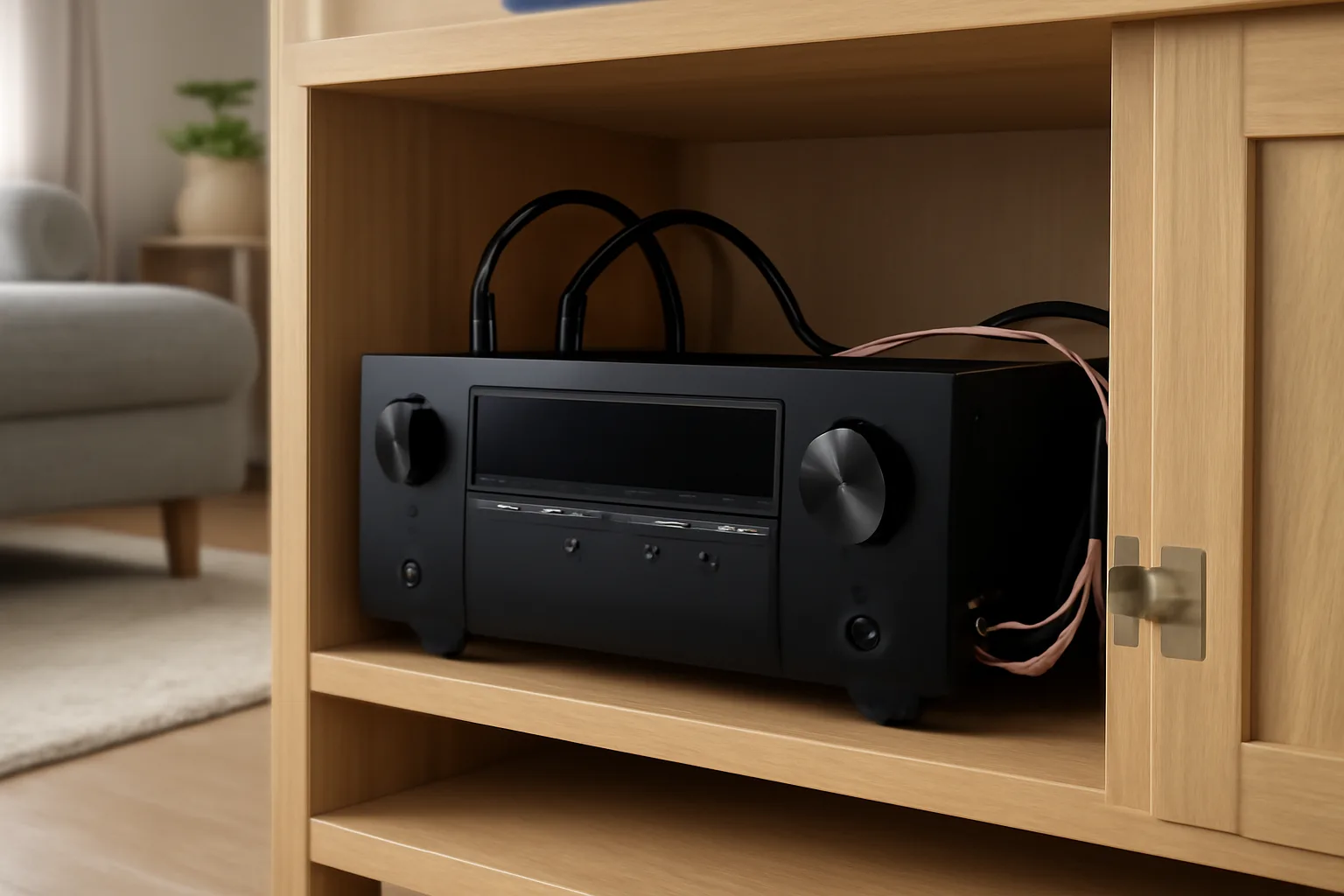
An AV receiver is the control hub for separate speakers. It decodes surround formats, switches HDMI sources, powers passive speakers and sends low bass to a subwoofer. The receiver itself does not make the system sound good on its own; the speakers, subwoofer, placement and setup all matter.
What a soundbar gives you
A soundbar is designed to be easy to live with. It sits under the TV or mounts on the wall, connects via HDMI eARC or optical, and usually works from your TV remote. Many soundbars also include Wi-Fi streaming, Bluetooth, app control, voice assistant support and room tuning.
The best soundbars are far better than the speakers inside almost any modern flat-panel TV. Dialogue is clearer because the centre channel is aimed at you, bass is fuller because the cabinet is larger, and the overall presentation feels less cramped.
A soundbar is also less intimidating. You do not need to choose speaker cable, decide between banana plugs and bare wire, or work out where to hide an AV rack. For a rented flat in Manchester, a terraced house in Bristol or a family lounge in Surrey, that matters.
What an AV receiver gives you
An AV receiver gives you separation. The centre speaker sits near the screen for dialogue. The front left and right speakers spread music and effects across the room. Surround speakers sit beside or behind you. A subwoofer handles the low frequencies that small speakers cannot reproduce with authority.
This physical separation is the key difference. A soundbar can use processing to make sound feel wider and taller, but it cannot fully replace speakers placed around the listener. If a helicopter moves behind you in a film, actual rear speakers have an advantage over a bar trying to bounce sound off side walls.
An AV receiver also gives you inputs and upgrade paths. You can connect a games console, Blu-ray player, streamer, set-top box and projector. You can start with three speakers and a sub, then add surrounds later. If one speaker fails or you fancy a better subwoofer, you can replace that part rather than the whole system.
The practical difference in one example
Imagine a 4m by 3.5m lounge with the sofa against the rear wall and a 65-inch TV on a media unit. A £500 to £900 soundbar with a subwoofer will make TV and film nights far more enjoyable than TV speakers. It will be tidy, quick to set up and easy for everyone in the house to use.
Now imagine the same room with a sofa pulled forward slightly, space for compact speakers on stands, and permission to run cable discreetly. A modest AV receiver with five small speakers and a subwoofer may cost more, but it will give you clearer placement of effects, more convincing scale and a system you can improve over several years.
Room Size, Seating and Neighbours
The best choice depends heavily on the room. A system that makes sense in a detached house with a converted garage can be a poor fit for a second-floor flat with thin walls and a sofa wedged into a corner.
Small flats and compact lounges
In a smaller UK room, a soundbar often wins. You may sit only two metres from the screen, have limited side-wall space, and need to avoid shaking the neighbour downstairs. A slim soundbar with a modest subwoofer or built-in bass can be easier to control than a full system.
That does not mean AV receivers are banned from small rooms. A compact 3.1 setup with left, centre, right and subwoofer can sound excellent without rear speakers. In fact, many people would get better dialogue and music from a well-chosen 3.1 receiver system than from an expensive bar placed badly.
The catch is furniture. If the TV is on a narrow unit, there may be no space for a centre speaker. If the sofa is against the back wall, rear speakers may sit too close to your ears. If you cannot run cables safely, the room is pushing you towards a soundbar.
Medium living rooms
A medium lounge is where the decision gets interesting. This is the classic UK family room: TV on one wall, sofa opposite, bookcase or fireplace limiting placement, and a partner who may not want black boxes everywhere.
A premium soundbar can work very well here, especially one with a separate subwoofer and rear speakers. It gives you a surround-like experience without the visual weight of an AV receiver system. If you stream Netflix, Disney+, Apple TV+ and BBC iPlayer more than you watch discs, this may be enough.
An AV receiver becomes more tempting if your seating position is central and you can place speakers symmetrically. You do not need huge floorstanders. Compact bookshelf speakers, a matching centre and a sealed subwoofer can be room-friendly and still offer a proper cinema feel.
Larger rooms and dedicated cinema spaces
In a larger room, an AV receiver starts to pull ahead. Soundbars rely on proximity, wall reflections and processing. In open-plan spaces with high ceilings, uneven walls or a wide seating area, those tricks become less reliable.
Separate speakers can fill space more confidently. They can be positioned to cover a wider sofa, calibrated for distance and volume, and upgraded if the room changes. If you are pairing audio with a large screen or projector, a receiver-based system usually fits the ambition better. If you are still choosing a display, the guide to the Best Projectors for Home Cinema 2026 is a useful companion because the screen size and speaker plan should be thought about together.
My own bias for larger rooms is clear: if the TV or projector screen is the main entertainment feature, I would rather spend on a good 5.1 receiver system than a flagship soundbar. The flagship bar may look cleaner, but the receiver system is more convincing once the volume rises.
Shared walls and late-night viewing
Neighbours matter. Bass travels through floors and walls more readily than many people expect. A powerful subwoofer can be thrilling at 8pm and antisocial at midnight.
Soundbars often include night modes, dialogue enhancement and bass reduction settings, which make them easier for late-night viewing. AV receivers also include dynamic range compression and centre-channel level adjustment, but they need more care to configure.
If you live in a flat, do not buy purely for maximum wattage. Look for control. A system with clear dialogue at moderate volume is more useful than one that only impresses when the subwoofer is rattling the radiator.
Sound Quality and Surround Effects
This is the heart of the soundbar vs AV receiver debate. A soundbar can be impressive, but an AV receiver has physical advantages that processing cannot fully erase.
Dialogue clarity
Dialogue clarity depends on the centre channel, speaker placement and room acoustics. Many soundbars improve speech because they put dedicated drivers close to the screen and process voices to stand forward.
An AV receiver with a proper centre speaker can do even better, especially if the centre is not buried inside a cabinet. You can raise its level, angle it towards ear height and match it with left and right speakers. If voices are your main complaint, a 3.1 AV receiver setup deserves serious thought.
That said, a poor centre speaker stuffed into a TV unit may sound boxy. A soundbar on top of the unit, with drivers firing cleanly into the room, can beat a badly installed receiver system. Setup matters more than brand loyalty.
Bass and impact
Most soundbars use small drivers, so they rely on a subwoofer for low bass. Wireless subs are convenient and often good enough for films, but they vary widely. Some deliver tight, useful bass; others boom around one note.
An AV receiver can work with a wider range of subwoofers. You can choose a model that suits your room, add a second sub later, and adjust crossover settings. For explosions, drums and cinematic weight, this flexibility is valuable.
For many homes, the goal should not be the deepest possible bass. It should be even bass that does not overpower speech or annoy the next room. A smaller, better-controlled subwoofer often beats a large boomy one.
Surround sound placement
A soundbar can produce a wide front soundstage and can sometimes bounce effects around the room. Models with rear speakers do a better job because they are no longer relying only on reflections.
A receiver-based surround system places speakers where the soundtrack expects them to be. That gives more precise movement, better envelopment and a stronger sense of space. Rain, crowd noise and background ambience feel more natural when they come from around you rather than from a single bar.
This is not just about action films. Nature documentaries, live concerts and big sports broadcasts all benefit from a wider, more open sound field. If you often watch with the lights down and no distractions, those details are part of the pleasure.
Dolby Atmos and DTS:X
Dolby Atmos and DTS:X add height information, allowing sound to be placed above as well as around you. Soundbars often create height through upward-firing drivers or virtual processing. AV receiver systems can use ceiling speakers, height modules or up-firing speakers.
If you want to understand the format differences before spending money, read Dolby Atmos vs DTS:X: Home Cinema Audio Formats Explained. It will help you avoid paying extra for a logo you may not be able to hear clearly in your room.
For layout guidance, the Dolby home theatre setup guide is a reliable reference for speaker positions in receiver-based systems. If you are leaning towards a bar, the Dolby soundbar setup guide shows why placement, ear height and room shape still matter.
My view on Atmos soundbars is cautious. Some are very enjoyable, especially with rear speakers, but I would not buy one expecting the same overhead bubble as a receiver with correctly placed height channels. Buy it for a cleaner, bigger presentation, with height effects as a bonus.
Cost, Upgrades and Long-Term Value
Price comparisons can be misleading because a soundbar is usually sold as one package, while an AV receiver system is built from several parts.
Typical UK prices
Entry-level soundbars start below £150, but these are mainly TV speaker upgrades. A good mid-range soundbar with a wireless subwoofer often sits around £300 to £700. Premium Dolby Atmos bars with rear speakers can reach £900 to £1,800 or more.
An AV receiver alone may cost around £350 to £900 for mainstream home cinema models, with higher-end units costing more. Add speakers and a subwoofer, and a sensible 5.1 package might run from about £800 to £2,000 depending on quality. Used or clearance speakers can reduce that cost.
If the budget is tight, plan the system in stages. The guide to How to Set Up a Home Cinema on a Budget is useful because it treats the room, screen, audio and priorities as one project rather than a shopping list.
Upgrade paths
A soundbar is easy to buy but harder to upgrade. Some brands let you add rear speakers or a subwoofer, but you are usually tied to that ecosystem. If the bar becomes outdated, you may replace the whole package.
An AV receiver system is modular. You can start with left and right speakers, add a centre, then a subwoofer, then surrounds. Later, you can improve the front speakers or change the receiver for newer HDMI features while keeping the speakers.
This matters if you expect to stay interested in home cinema. Many enthusiasts begin with a simple 3.1 setup and build slowly. The system improves as funds allow, and no single purchase has to do everything on day one.
Resale and lifespan
Speakers can last a long time if treated well. A good pair of passive speakers may serve through several receiver upgrades. AV receivers age faster because HDMI standards, gaming features and surround formats change, but the speaker investment remains useful.
Soundbars are more like consumer electronics. They are convenient, but they combine amplification, processing, inputs, drivers and wireless features in one unit. If one part becomes outdated or fails, repair and upgrade options are limited.
That does not make soundbars poor value. A £500 bar used every evening for five years may be one of the best entertainment purchases in the house. Value depends on use, not just lifespan.
Hidden costs
AV receiver systems can bring extra costs: speaker stands, wall brackets, cable, cable trunking, subwoofer isolation pads and possibly a larger TV unit. You may also need time and patience.
Soundbars have fewer extras, but check the details. Some models charge extra for rear speakers. Some have only one HDMI input. Some are too tall and block the bottom of the TV. Some need a newer TV with eARC to pass lossless audio formats properly.
Before buying, measure the TV stand, count HDMI devices and check how much space you have behind furniture. These boring checks prevent expensive frustration.
Ease of Setup and Daily Use
The best system is the one people in the house are happy to use. A technically superior setup that confuses everyone may end up switched off.
Setting up a soundbar
A soundbar setup is usually simple. Connect HDMI eARC from the TV to the bar, plug in the power, pair the subwoofer if needed, and run any room calibration app. Most TVs then pass sound from built-in apps and HDMI devices to the bar.
You still need to check settings. Set the TV audio output to the correct format, enable eARC if available, and test lip-sync. If dialogue feels detached from the picture, small delay adjustments can help.
Placement is important. The bar should not be hidden in a shelf, blocked by ornaments or pushed too far back on the unit. Upward-firing Atmos bars need a clear path to the ceiling, so avoid placing them under a deep shelf.
Setting up an AV receiver
An AV receiver setup takes longer. You connect sources, run speaker cable, assign channels, plug in the subwoofer and use the supplied calibration microphone. You then review distances, levels and crossover settings.
Many receivers make this process manageable, but it is still more involved than a soundbar. The reward is control. If the centre is too quiet, raise it. If the subwoofer is too heavy, trim it. If surrounds distract you, lower them a little.
Do not rush speaker placement. A receiver cannot fully fix a centre speaker trapped behind a solid cabinet door or surrounds firing into the back of someone’s head. Ten minutes moving speakers can do more than an hour in menus.
Family use and remote control
Soundbars tend to be easier for mixed households. Turn on the TV, and the bar wakes up. The TV remote controls volume. Apps like Netflix and Prime Video work as expected.
AV receivers can be just as smooth once configured, but they introduce source switching and input naming. If you have Sky, a PS5, Apple TV and a Blu-ray player, label inputs clearly and consider HDMI-CEC carefully. It can be helpful, but it can also switch inputs at the wrong moment.
For a shared lounge, I would prioritise reliability over clever features. If everyone can press one button and get sound, the system will be used. If it needs troubleshooting twice a week, the novelty will fade.

Which Should You Choose for Common UK Rooms?
Different rooms push the decision in different directions. Here are practical examples rather than abstract rules.
Rented flat with a 50-inch TV
Choose a soundbar. You may not be allowed to drill walls, run cable or mount rear speakers. A compact bar with clear dialogue and moderate bass is likely to suit the room and keep the deposit safe.
Look for HDMI eARC, a useful night mode and a subwoofer you can turn down. If space is tight, a bar without a separate subwoofer may still be a major upgrade over TV speakers.
Family lounge with a 55-inch or 65-inch TV
This is the hardest call. If the room is busy, furniture is fixed and aesthetics matter, a soundbar with subwoofer is the lower-friction choice. Add wireless rears only if you can place and power them neatly.
If the family likes film nights and you can place speakers without domestic tension, consider an AV receiver with a compact 5.1 package. It does not need to dominate the room. White speakers, slim stands and tidy cable routes can make a proper system easier to accept.
Gaming setup with PS5 or Xbox Series X
Both options can work, but check HDMI features carefully. Gamers may need 4K/120Hz, VRR and low latency passthrough. Some soundbars and receivers support these fully; others do not.
If you connect the console directly to the TV and send audio back via eARC, a soundbar can be simple. If you have several sources and want the receiver as the switching hub, buy an AV receiver with the right HDMI 2.1 support.
For immersion, a receiver with real surround speakers has the edge. Directional cues in games are more convincing when the rear and side information comes from actual speakers.
Projector room or converted garage
Choose an AV receiver in most cases. Projectors usually sit away from the sources, and you need a hub for HDMI switching, audio decoding and speaker amplification. A soundbar under a projector screen can work, but it may not match the scale of a 100-inch image.
A projector room also gives you more freedom to place speakers correctly. If you have gone to the trouble of controlling light and creating a cinema feel, separate speakers complete the experience.
Music as well as films
If music matters, be careful with soundbars. Some are enjoyable for background listening, but stereo imaging and tonal balance can be limited by the narrow cabinet.
An AV receiver with good front left and right speakers is usually better for albums, concerts and radio. You can also run a 2.1 or 3.1 setup first and add surround speakers later.
Buying Checklist Before You Decide
Before spending money, answer these questions in the room where the system will live. Do not do it from the sofa in a shop or from a product page on your phone.
- Where will the centre of the screen be, and where will your ears be when seated?
- Can you place left and right speakers at a sensible distance apart?
- Is there space for a centre speaker, or would a soundbar fit better?
- Can you run speaker cable safely and neatly?
- Do you need night listening modes for neighbours or children?
- How many HDMI devices do you need to connect?
- Does your TV support eARC, and are you using built-in streaming apps?
- Is the room open-plan, square, narrow, or full of reflective surfaces?
- Will anyone object to visible speakers, stands or cables?
- Do you want a one-time purchase or a system you can upgrade?
Choose a soundbar if most of these are true
- You want a neat, low-clutter solution.
- You live in a flat, rental property or compact room.
- You mainly stream TV and films.
- You want quick setup and easy daily use.
- You do not want to run speaker cables.
- You prefer one brand package with app control.
- You value better TV sound more than hobby-level home cinema.
Choose an AV receiver if most of these are true
- You want real surround sound from separate speakers.
- You have space for at least a 3.1 or 5.1 layout.
- You own several HDMI sources.
- You use a projector or large screen.
- You want stronger bass control and upgrade options.
- You care about film soundtracks, gaming immersion or music quality.
- You are happy to spend time setting the system up properly.
Mistakes to avoid
Do not buy the biggest soundbar you can afford if it blocks the TV or overwhelms a tiny room. Do not buy an AV receiver if every speaker will be squeezed into the same cabinet under the screen. Do not chase channel numbers without checking where those channels will physically go.
Also avoid assuming that more watts means better sound. Manufacturers quote power in different ways, and room behaviour matters more than headline numbers. Speaker quality, placement and calibration make the bigger difference.
One practical trade-off many owners notice: a mid-priced system installed well often beats a pricier system installed carelessly. If your budget is £1,000, keeping £100 aside for stands, brackets, cable management or a better TV unit can be wiser than spending every pound on electronics.
Final Verdict: Soundbar vs AV Receiver
The soundbar vs AV receiver choice is really a choice between convenience and capability.
A soundbar is the right answer for many people. It is tidy, quick to install, easy to use and a large upgrade over TV speakers. In a normal UK lounge where the room has to remain a lounge, a good soundbar with a subwoofer is often the product that fits real life.
An AV receiver is the better answer for people who want the room to feel like a cinema. It gives you proper speaker placement, stronger upgrade options, better source handling and more convincing surround sound. It asks more from you: money, space, setup time and tolerance for cables. In return, it can deliver a level of immersion a single bar struggles to match.
If I were choosing for a compact flat, I would buy a well-reviewed soundbar, keep bass under control and enjoy the simplicity. If I were choosing for a projector room, gaming den or film-focused lounge, I would build around an AV receiver, even if that meant starting with fewer speakers and upgrading over time.
The best decision is not the most expensive one. It is the one that suits your room, your habits and the people who share the space.
Two linked choices often decide the result before you buy anything. If you are staying with a bar, compare current UK options in our best soundbars UK guide. If you are leaning towards separates, start with how to choose speakers for your room size before obsessing over amplifier power.
Frequently Asked Questions
Is a soundbar better than an AV receiver? A soundbar is better for simplicity, neatness and quick TV sound upgrades. An AV receiver is better for real surround sound, speaker separation, bass control and future upgrades. The better choice depends on the room and how much effort you want to put into setup.
Do I need an AV receiver with a soundbar? No. A soundbar has its own amplification and processing built in, so it connects directly to your TV, usually through HDMI eARC or optical. An AV receiver is designed for passive speakers, not for powering a normal soundbar.
Can a soundbar give real Dolby Atmos? Some soundbars can play Dolby Atmos soundtracks and create height effects using upward-firing drivers or virtual processing. They can be enjoyable, but a receiver with correctly placed height or ceiling speakers usually gives a more convincing Atmos experience.
Is an AV receiver too much for a small UK living room? Not always. A compact 3.1 receiver setup can work very well in a small room and may give excellent dialogue and music. A full 7.1 system may be excessive if the sofa is against the wall or speakers cannot be placed sensibly.
How much should I spend on a soundbar or AV receiver system? For a worthwhile soundbar, many UK buyers should budget around £300 to £700, with premium packages costing more. For an AV receiver and 5.1 speakers, a sensible starting range is often £800 to £2,000, though buying in stages can reduce the initial cost.
Which is better for a projector setup? An AV receiver is usually better for a projector setup because it can switch HDMI sources, decode surround formats and power speakers placed around the room. A soundbar can work with a projector, but it may not match the scale of a large screen.
Can I upgrade a soundbar later? Sometimes. Some soundbar systems allow optional rear speakers or a matching subwoofer. Upgrade options are usually limited to the same brand ecosystem, while an AV receiver system gives far more freedom to change speakers, subwoofers and electronics over time.