The Q Acoustics 3020i is the best bookshelf speaker for most UK hi-fi systems. It is compact enough for ordinary rooms, easy to partner with a sensible stereo amplifier and large enough to sound convincing without demanding floor-standing space. Choose the Edifier R1280DBs when you want amplification and digital inputs built in, or the KEF Q350 when you have more room and suitable stands.
Best Bookshelf Speakers at a Glance
The first decision is active or passive. Active speakers contain amplification and connect directly to suitable sources; passive speakers need a separate amplifier but make future upgrades and source switching easier.
| Speakers | Verdict | Type | Best use |
|---|---|---|---|
| Edifier R1280DBs | Best budget active speakers | Active | Desktop, TV and simple turntable setups |
| Q Acoustics 3020i | Best overall passive speakers | Passive | Small-to-medium rooms |
| Wharfedale Diamond 12.1i | Best balanced passive option | Passive | Music-first stereo systems |
| ELAC Debut 2.0 B5.2 | Best value for fuller bass | Passive | Medium rooms and stands |
| KEF Q350 | Best for wide placement flexibility | Passive | Larger stands and open rooms |
| Audioengine A5+ Classic | Best premium active pair | Active | Simple premium analogue system |
The Six Best Bookshelf Speakers
1. Edifier R1280DBs — Best Budget Active Speakers
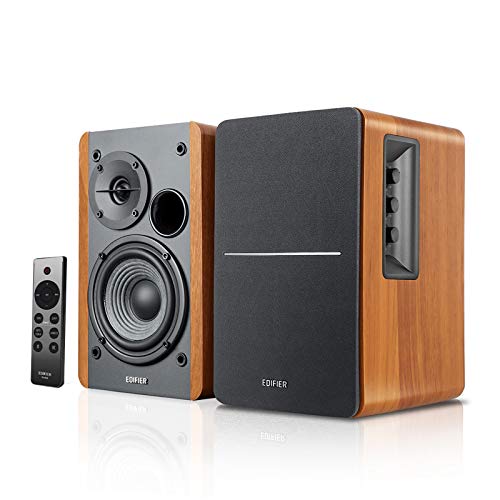
The Edifier pair combines amplification, Bluetooth, optical, coaxial and analogue inputs in one box, plus a subwoofer output. That makes it a practical upgrade for a TV, computer or simple turntable system without buying a separate amplifier.
Its 42W RMS system and 4-inch drivers are intended for near-field or modest-room listening, not party levels across a large open-plan space. A turntable still needs a built-in or external phono stage.
- Best for: Desktop, TV and simple turntable setups.
- Before buying: confirm pair quantity, inputs and amplifier requirements on the exact listing.
2. Q Acoustics 3020i — Best Overall Passive Speakers

The 3020i uses a 125mm mid/bass driver and 22mm tweeter in a manageable cabinet. It is the easiest passive recommendation here because it balances room friendliness, conventional amplifier matching and enough scale for everyday music and television.
It still needs an amplifier, speaker cable and stable stands or furniture. The rear port means very close wall placement can thicken bass, so leave adjustment room rather than wedging it against a back wall.
- Best for: Small-to-medium rooms.
- Before buying: confirm pair quantity, inputs and amplifier requirements on the exact listing.
3. Wharfedale Diamond 12.1i — Best Balanced Passive Option

The Diamond 12.1i is a compact music-first alternative for listeners who want a traditional passive system. Its size suits small-to-medium rooms, and the current pair makes sense with an integrated amplifier rather than a complicated home-cinema receiver.
The listing provides limited technical detail, so confirm impedance, sensitivity and finish with the retailer before matching an amplifier. Do not choose by nominal wattage alone.
- Best for: Music-first stereo systems.
- Before buying: confirm pair quantity, inputs and amplifier requirements on the exact listing.
4. ELAC Debut 2.0 B5.2 — Best Value for Fuller Bass

The ELAC B5.2 uses a 5.25-inch aramid-fibre woofer and front-firing port. The front port gives more flexibility near a wall than many rear-ported rivals, while the larger cabinet is suited to listeners wanting more weight than tiny desktop speakers.
It is physically deeper than it first appears and still benefits from stands. Fuller bass does not remove the need for careful placement, and a subwoofer may still be useful for films or genuinely deep electronic music.
- Best for: Medium rooms and stands.
- Before buying: confirm pair quantity, inputs and amplifier requirements on the exact listing.
5. KEF Q350 — Best for Wide Placement Flexibility

The Q350 uses KEF’s concentric Uni-Q driver concept, placing the tweeter within the mid/bass driver. That layout is designed to create consistent dispersion and can help across a wider seating area. The cabinet and driver are larger than the compact options here.
This is a single-listing title that may be ambiguous about pair quantity, so confirm the package before ordering. The Q350 also needs substantial stands and enough distance from boundaries to avoid overwhelming a small room.
- Best for: Larger stands and open rooms.
- Before buying: confirm pair quantity, inputs and amplifier requirements on the exact listing.
6. Audioengine A5+ Classic — Best Premium Active Pair
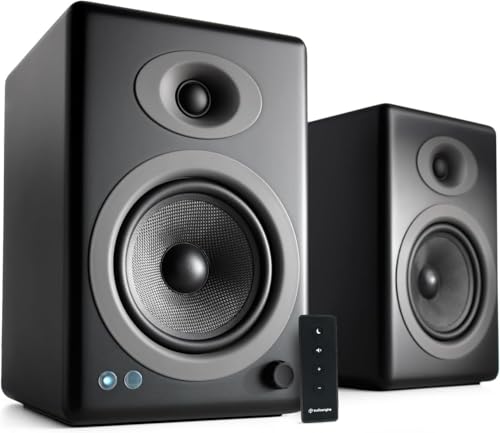
The A5+ Classic provides built-in analogue amplification, a remote, RCA and 3.5mm inputs in a simple powered pair. It suits someone who wants better scale than budget desktop speakers without assembling an amplifier-and-speaker stack.
This exact Classic version is analogue rather than the Bluetooth A5+ Wireless model. Add an external DAC, streamer or phono stage when the source requires it, and note that the listing is currently scarce.
- Best for: Simple premium analogue system.
- Before buying: confirm pair quantity, inputs and amplifier requirements on the exact listing.
Active vs Passive Speakers
Active speakers reduce box count and remove basic amplifier matching. They are ideal for desks, televisions and simple streaming systems. Their downside is that an amplifier fault affects the whole product, and upgrading one part is harder.
Passive speakers require an amplifier but give more freedom over inputs, streaming, phono stages and later upgrades. They are usually the better foundation for a traditional living-room hi-fi system.
Matching Speakers and Amplifiers
Use the speaker maker’s stated impedance and recommended amplifier range as boundaries, not a promise that every combination will sound identical. An amplifier driven into clipping can damage tweeters even when its printed wattage looks modest. Sensitivity affects how loudly a speaker plays for a given power.
- Check impedance: ensure the amplifier supports the speaker’s nominal and minimum load.
- Allow headroom: clean power is safer than an undersized amplifier driven into distortion.
- Use sensible volume: harshness, compression or obvious distortion means back off.
- Confirm connections: active speakers take source signals; passive speakers take amplified speaker-level output.
Placement, Stands and Room Size
“Bookshelf” describes size, not ideal placement. A rigid stand puts the tweeter near ear height and keeps cabinets clear of resonant furniture. Start with the speakers forming roughly an equal-sided triangle with the listening position, then adjust toe-in and wall distance.
Rear-ported speakers usually need more breathing room than front-ported models, though every room behaves differently. Small speakers do not automatically suit a small room if pushed into corners, and large speakers do not guarantee deep, controlled bass.
Inputs, TV and Turntables
For a TV, optical input is convenient but volume control behaviour varies. Edifier includes optical; Audioengine Classic does not. For a turntable, check whether the deck has a phono preamp. Neither an ordinary active line input nor a standard integrated-amplifier input automatically accepts a bare moving-magnet cartridge.
Bluetooth is convenient, but codec labels matter less than speaker placement and source quality in most rooms. Our DAC guide covers adding digital sources to analogue systems.
Final Verdict
Choose Q Acoustics 3020i for the best all-round passive system. Edifier R1280DBs is the budget active winner, while Wharfedale 12.1i and ELAC B5.2 offer alternative passive balances. KEF Q350 suits a larger setup, provided the listing quantity is confirmed. Audioengine A5+ Classic is the premium active choice for analogue simplicity.
Frequently Asked Questions
Do bookshelf speakers need an amplifier?
Passive models do; active models contain amplification. Check the exact product type before ordering.
Can bookshelf speakers connect directly to a TV?
Only active speakers with a compatible TV output can connect directly. Passive speakers need an amplifier or receiver between them.
Do I need speaker stands?
Not always, but rigid stands at ear height usually improve positioning and reduce furniture vibration.
Can I connect a turntable directly?
Only when the turntable or speaker system includes the required phono stage. Otherwise add an external phono preamp.
Are bigger bookshelf speakers better?
No. Bigger cabinets may provide more bass and output, but room fit, placement and design matter more than size alone.
How far should speakers sit from the wall?
Start with the maker’s guidance and adjust by listening. Rear-ported speakers often need more space than front-ported designs.